By April C. Armstrong *14
In this week’s installment of our recurring series, a student marvels at local climate control systems, a new campus map is available, and more.
January 5, 1835—John L. Manning, Class of 1837, writes to his mother about the heating systems in use locally, which he observes are quite different from South Carolina.
The houses are all warmed underneath by stoves, besides the fireplaces. I really wonder how we have lived at the South. The stores even in town have glass doors and are warmed in that way. The Episcopal Church is kept as warm as possible when you are in there and feels as if you were in a delightful wild Spring day and just step out, the cold freezes your very flesh. The weather is much colder than ours.
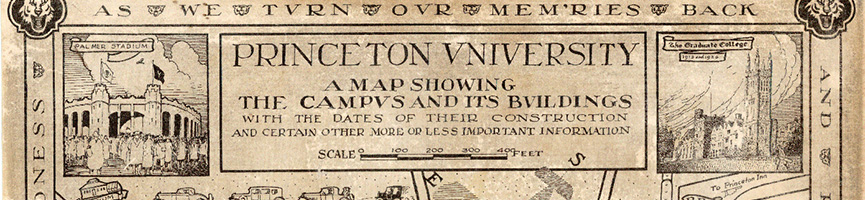
January 6, 1933—Interested buyers may purchase a new whimsical map of Princeton drawn by Jacob Riegel, Jr., Class of 1912. Though depicting buildings as three dimensional, they are scaled for the two-dimensional map and accurately placed. The cost is $1.50 for a black and white version, $10 for orange and black, and $25 for mounted and varnished watercolor. (In 2026 dollars, this will be $38, $250, and $630, respectively.)

January 7, 1876—At a meeting of the New York Alumni Association of Princeton College, Hugh L. Cole (Class of 1859) reports that the Trustees have not yet been amenable to the alumni’s insistence that the ban on secret societies be repealed.
January 8, 1986—The Graduate Board of Cottage Club votes 11-8 to admit women. Alumni who graduated prior to 1970 have generally favored making the club coeducational by 67%, while of those who graduated after 1970, 60% want the club to remain all-male. This generational divide is even more pronounced when compared to current students; in November 1985, more than 80% of undergraduate members of the club voted to remain all-male.
Did you read the previous installment in this series?
Fact check: We always strive for accuracy, but if you believe you see an error, please contact us.
One response to “This Week in Princeton University History for January 5-11”
[…] Did you read the previous installment in this series? […]