
This post is the first in a two-part series examining daily foodways at Princeton.
Today, most Princetonians are likely to take it for granted that they can have a bagel with cream cheese and lox in the morning, pick up Chinese takeout for lunch, and relax over a dinner of spaghetti, but all of these things were unheard of for most of Princeton’s past. Indeed, many of the things considered standard American fare today were once mysterious and exotic. The converse is also true—we don’t expect many students today to have much experience with turtle soup or roasted peacocks, for example.
It can be a challenge to figure out what people actually ate on a day-to-day basis in earlier centuries. Many of the menus available in our collections are more of a guide to special occasion fare than they are for the everyday meals people ate to fuel studying, research, and teaching. However, through letters, diaries, editorials, advertisements, and other documentation in the University Archives, we also find glimpses of a changing palate that maps well onto a broader history of American foodways. This two-part series looks back at centuries of expansion from the daily snacks of bread and butter with “small beer” the Board of Trustees authorized in 1765 to the sushi and falafel delivered to dorms in the late 20th century. This first post considers the antebellum student’s diet, while the second will unveil the postbellum diversity in options for meals. When one looks into what was available in the antebellum period, economic concerns had a clear influence on foodways at Princeton, but consistent themes emerge in spite of this.

The basic fare of the 1760s was reportedly a breakfast of tea and coffee, followed by a dinner of “almost all the variety of fish and flesh the country here affords, and sometimes pyes.” Beverages, on the other hand, had little variety. “The general table drink is small beer or cyder; chocolate is sometimes served as a change.” Though there were no “luxurious dainties or costly delicacies,” students could have all they wanted “without weight or measure allowance.”
The American Revolution brought financial devastation to Princeton. It took decades to recover. This is reflected in what foods were available. Some eighteenth-century students struggled to find positives in the midst of the institutional privation. Peter Elmendorf (Class of 1782) wrote to his mother in 1781 to complain:
We eat rye bread–half dough and as black as it possibly can be, old oniony butter and sometimes dry bread, and thick coffee for breakfast. A little milk or cyder, bread, and sometimes meagre chocolate for supper. Very indifferent dinners, such as lean, tough, boiled fresh beef with dry potatoes, and if this deserves to be called diet for mean ravenous people let it so be stiled [sic] and not a table kept for collegians!
Another student remarked on any deviations from the usual offerings in his diary in 1786, reflecting just how often he expected similarly “indifferent dinners.” “The lads [are] all fearful that something extraordinary is going to happen soon, as today we had cucumbers for dinner.” For another meal, this anonymous student had “Chocolate Tea and Bread and Butter for supper, for a wonder, but not to be continued.”
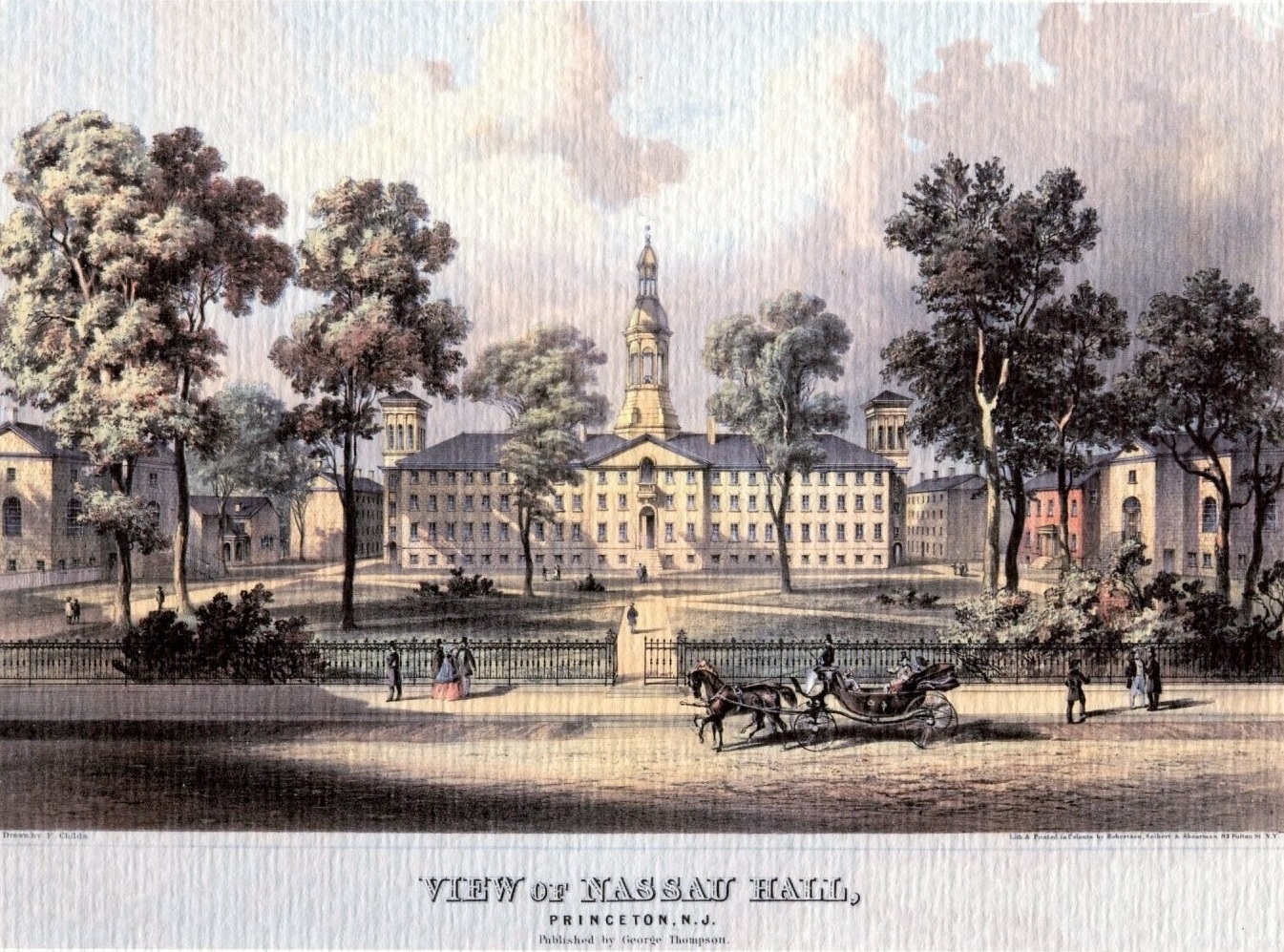
Financial hardship for the institution was ongoing. The Nassau Hall fire of 1802 was a serious blow, followed by another economic crisis: The War of 1812. As America at large struggled with the interruptions to commerce following the war, student dining became bleaker. A beverage made from brewed beans and rye sweetened with molasses took the place of coffee sweetened with sugar in 1813. Nonetheless, in 1815, the Board of Trustees heard a report that “the style of living in the refectory is more luxurious than it ought to be,” and they ordered the steward to cut out any unnecessary expenditures.
Economic expansion in the mid-1830s might have influenced the student diet in a more “luxurious” direction. A letter Edmund Lang wrote to his father in 1834 described a similar menu to Elmendorf’s, but with a twist, which he said the students called “good dinner day”:
Firstly, on ordinary days we have one roll apiece about half the size of a six-penny loaf of bread for breakfast and also coffee. For dinner we have beef or some other meat with potatoes and two apples.
For tea we have coffee, bread, and generally cheese or something of the kind, but we have one day, Friday, which we call ‘good dinner day’, when we have poultry of some kind[,] applesauce, and pie. One day we had a kind of poultry I had never tasted before and they were peacocks.
By contrast, an anonymous student wrote an account of rather meager food in 1841, describing “our usual supper” as consisting of “one or two pieces of bread & a bowl of Coffee.” Though this fell in the midst of the recession following the Panic of 1837, it may also describe the cheaper option Princeton offered from 1834-1846, in a second, smaller refectory known on campus as the “Poor House.” There, an account depicts students often being presented with pans of hard boiled eggs, milk, toast, and butter “old enough to speak for itself” as a meal. “Ram’s Pie,” a mutton stew, was another dish frequently served at the “Poor House.” Frustrated with the quality of the food, Edward Shippen (Class of 1845) reported that students frequently responded to bad meals by throwing all of the dishes, cutlery, and tablecloths out the window.

At the so-called “Old Refectory,” where costs were higher, one generally found a breakfast of buckwheat pancakes and coffee for breakfast in the 1840s. As for other meals, Charles Colcock Jones (Class of 1852) described the campus food as “only tolerable: generally beef, Irish potatoes, and bread, accompanied now and then at dinner by a dish of stewed tomatoes.” It was typically clean, he said, but “Now and then, nevertheless, a stewed fly is found among the extra articles of diet.” He wrote to his family about the sheer monotony of the meals: “Our regular routine in the refectory is bread (stale oftener than fresh), beef, potatoes, and again (by way of variety) potatoes, beef, bread.” There are other sources to suggest the most typical meal a student would encounter in the 1850s would have a main dish of beef, a clear continuity across the decades in the antebellum period, though one finds occasional references to roast turkey, especially on holidays.
Jones was thus grateful for any change of pace. A professor’s wife (McCulloh) sent him apples in 1850, “for which I was much indebted to her, for every little helps in our present mode of living.” His parents sent oranges and cake in February 1851, “a treat which the student seldom has the pleasure of enjoying during his college course…” That October, Jones had dinner at John Maclean’s house with a few other students and professors, and noted that “the chicken salad, ice creams, and cakes were not lost upon refec boys used to ‘light bread and beef.’”
As the institution grew, lot of students began boarding in town rather than having their meals in the refectory. There were a variety of options available to students who preferred to eat off campus, from paying to board with local families or boarding houses to forming their own eating clubs. In the 1850s, many college students chose to eat at the refectory at Princeton Theological Seminary. Now and then, eighteenth-century students were expelled for stealing poultry. Many students in the mid-19th century frequented an eatery run by Anthony Simmons, including John Robert Buhler of the Class of 1846. Buhler wrote in his diary often about enjoying oysters, ice cream, and something called “Horace” that he described as “fine, fat, and greasy” there. (What this dish was is lost to time.) Sam Parker would reportedly bring stuffed roasted turkeys and pitchers of ale to students who paid him in either cash or discarded clothing in this era as well.
In 1855, a fire’s significant damage to Nassau Hall meant closing the College refectory. For more than two decades following the fire, the College simply didn’t offer a meal plan of any kind to students, leaving them to fend for themselves, giving rise to new foodways that will be examined in next week’s post in this series.
Sources:
Alexander, James W. Princeton, Old and New: Recollections of Undergraduate Life. New York: C. Scribner’s Sons, 1899.
Board of Trustees Records (AC120)
Collins, Varnum Lansing. Princeton. New York: Oxford University Press, 1914.
Jones, Charles Colcok. A Georgian at Princeton, ed. Robert Manson Myers. New York: Harcourt, 1976.
Norris, Edwin Mark. The Story of Princeton. Boston: Little, Brown, and Company, 1917.
Shippen, Edward. “Some Notes about Princeton.”
Steward and Refectory Records (AC032)
Undergraduate Alumni Records 1748-1920 (AC104)
For Further Reading:
Looney, J. Jefferson. “‘An Awfully Poor Place’: Edward Shippen’s Memoir of the College of New Jersey in the 1840s.” Princeton Univeristy Library Chronicle 59, No. 1 (Autumn 1997): 9-14.