By Eojin Park ’28
Introduction
Religion has long served as both a source of comfort and a foundation for community life. For many Korean students who came to the United States in the early twentieth century, however, Christianity played a particularly distinctive role. As detailed by Lee Houchins and Chang-su Houchins, many of the first Korean students who arrived in the U.S. did so at the encouragement of Christian missionaries in Korea, who urged them to study “Western life and thought” at American universities. As a result, Korean international students in the beginning of the twentieth century would have likely been heavily influenced by the religious education and Christian networks they carried with them from home.

The strong religious foundation ingrained in Korean students was a direct consequence of the spread of Christian missions throughout the Korean Peninsula, which included various branches of Christianity. Among these, Protestantism proved especially influential: the Journal of Korean Studies documented it in 1992 as making “an unparalleled growth [in Korea] for a century” alongside Roman Catholicism. In 1909, the two primary Protestant denominations in Korea— Methodism and Presbyterianism — divided the country into areas of missionary activity under the Comity agreement. While the two factions differed in method, their shared commitment to Christian education, social service, and institution-building would significantly shape Korean society. Missionaries established schools from kindergarten to college teaching a “modern curriculum” that included science, as well as founded Korea’s first orphanages and schools for the blind.
According to the Pew Research Center, only about 1% of Korea’s population identified as Christian in 1900. By 2010, however, roughly three-in-ten South Koreans identified as Christian — a transformation rooted in the enduring influence of those early missions. This religious growth is also reflected in the Korean immigrant population: Paul S.N. Lee notes the saying “If three Koreans [get together], they will start a church.” The saying may ring true to an extent: according to Lee, as of 1994, there were close to 2,000 Korean American churches across the United States, or roughly one church for every 300 Koreans—a significantly smaller ratio in contrast to how there was one church for every 730 Americans. By 2019, that number had grown to 4,454 Korean immigrant churches, serving a Korean-identified population of about 1.9 million.
Overall, faith and identity were often deeply intertwined in the Korean immigrant experience, especially during the nineteenth century due to both missionaries’ influence and the vibrant Korean American Christian community. Princeton’s Korean alumni may have found a spiritual connection to home by continuing to engage with their Christian faith and practicing the religion throughout their lives and activities at the University, as will be seen below.
Many of these Princeton students, whether Korean international students or Korean Americans, also took classes or were dually enrolled at the Princeton Theological Seminary (PTS). PTS is a private school of theology in Princeton that “prepares women and men to serve Jesus Christ in ministries. A separate institution from Princeton University, the two institutions share a “relationship of academic reciprocity,” which likely enabled the alumni listed below to pursue religious classes in Christianity at PTS. The biographical information below therefore draws from both the Graduate Alumni Records at Princeton University Library and Wright Library’s Special Collections at PTS.
What follows highlights several Korean alumni whose academic and ministerial pursuits at Princeton and its Seminary reveal the long-standing connections among faith, intellect, and Korean identity.
1. Hern Joo Song, Graduate Class of 1915 (송헌주)
Hern Joo Song, originally from Seoul, South Korea, earned his A.B. from Roanoke College in 1914, after which he enrolled at Princeton University the same year to study History and Politics, completing an A.M. in 1915. His coursework ranged from American history to diplomacy and philosophy, reflecting his broad intellectual curiosity.

Song was also enrolled at PTS from 1915 to 1916. Though specific course records are absent from his alumni file at Wright Library, his continued correspondence with the Seminary — including a postcard noting his move to Los Angeles in 1953 — suggests a lasting connection to PTS.
According to a 1988 letter from his granddaughter Dr. Ki Kim — included in Song’s Graduate Alumni Record file in the University Archives — he dedicated his life in the United States to resisting Japanese occupation in Korea. His fusion of theological conviction and political activism demonstrates how, for many Korean Christians, religious commitment remained inseparable from the pursuit of national independence and justice.
2. Julian Park, Graduate Class of 1922 (박준섭)
Park was born on June 22, 1895 in San Francisco, California. He enrolled at Princeton University on September 25, 1919, and re-enrolled the following year. Before arriving in Princeton, he completed his secondary education at Los Angeles High School and earned his Bachelor of Arts from Baldwin-Wallace College in 1918. Park went on to pursue a Master of Arts at Princeton, graduating in 1922, while simultaneously attending PTS between 1920 and 1922.
Park worked as a pastor throughout his life in Presbyterian churches in Philadelphia, preaching first at the Union Dale Presbyterian Church from 1923-1925, then at the Gibson Memorial church in 1925-1932, and finally at the Duncansville Presbyterian Church from 1923-1966. He also worked as an “agent and manager” at the Equitable Life Assurance Society’s Pittsburg Office from 1939-1969.
He later passed away on April 3, 1981 in his home, following an “extended illness.” He was survived by his wife, Mildred E. Tate , who he married in 1930, as well as two sons: Reverent J. Philip Park, who also graduated from PTS in 1958 and later became the Associate Director of the Asian Mission Development Program; and Dr. Arthur R. Park, Associate Professor of Art Education at Wayne State University.
3. Hyek Nam-Kung, Graduate Class of 1923 (남궁혁)
Hyek Nam-Kung — whose family name, “Nam” was incorrectly recorded as part of his family name in the records maintained in the University Archives — was born in Kwangju (now Gwangju), Korea, where he completed his early education at Pai Chi secondary school before graduating from the Union Theological Seminary of Pyongyang in 1921. He later enrolled at Princeton University on September 26, 1922, to pursue studies in Philosophy, though he withdrew the following year.
Hyek was simultaneously enrolled in the PTS from 1922 to 1924, illustrating the dual path many Korean scholars took, balancing academics at the University with theological commitment at PTS.
4. Syung-Whee Lee, Graduate Class of 1923 (이성휘)
According to the Personal Data Form in the PTS’ 1977 Biographical Catalogue, Syung-Whee Lee was born in “Long Chunu”, Korea; however, his place of birth is also listed as Pyongyang in the University graduate alumni records. He was first inducted into the Christian faith at Koobong Church, North Korea, at age 16. Lee later applied to Princeton under the Department of Philosophy, intending to study the history of ethics as a candidate for the master’s degree, graduating in 1923.
Lee’s earlier education at the Union Christian College of Pyongyang between 1909 and 1913 linked him to the vibrant Christian academic scene in Korea. Lee’s credentials from the San Francisco Theological Seminary in California also earned him admission to the PTS, where he was enrolled from 1922-1923.
While at Princeton, Lee lived in 310 Hodge Hall at PTS with his wife — whose name is recorded as Kyem Nang Lee in PTS’ Biographical Catalogue — whom he married in 1913. According to Lee’s submission for a PTS’ request for information from formal students for a Biographical Catalogue, he later worked as a preacher in Pyongyang from 1924-1929 at the Soong-Sill College and the West-Gate Church, then as a professor of astronomy at the Union Christian College.
5. Channing Liem, Graduate Class of 1946 (임찬휘)
Born in Pyongyang on September 9, 1909, Channing Liem embodied the archetype of the scholar-pastor. After earning a diploma from Union Christian College in 1930, he studied at Lafayette College (B.S., 1934) and later at Princeton University, where he obtained an A.M. in 1943 and a Ph.D. in 1946.
Liem’s earlier studies at Bucknell University (1934–35) and the Biblical Seminary in New York (1935–39) prepared him for a life of ministry and teaching. Between 1936 and 1941, Liem served as pastor and director of the Korean Church and Institute in New York City, where he led Methodist congregations and promoted education among Korean immigrants.
Liem was also enrolled at PTS. Interestingly, Liem’s wife, “Mrs. Channing Liem,” whose full name was Po Pai Lee, was also enrolled at PTS from 1939-1940; however, she did not complete more than one course “on account of her health and the responsibilities of [the Liem’s] new home.” The Liems were described by then-Head of the Biblical Seminary Dr. Dean McKee as “a most worthy couple” in a letter dated to October 22, 1941 to the U.S. Department of Justice Immigration and Naturalization Service after Lee’s immigration status was questioned.
While at Princeton, Liem was awarded both the Sanxay Fellowship in Practical Ethics (1942–44) and the Class of 1883 Fellowship in Politics (1944–45), signaling recognition of his dual interest in moral philosophy and public life. Reflecting on his time in seminary, Liem wrote, “I completed my studies in the Biblical Seminary while serving at its Korean Church…I shall receive a degree of S.T.B when I complete my thesis.”
6. Surh Byung Kyu, Graduate Class of 1899 (서병규)
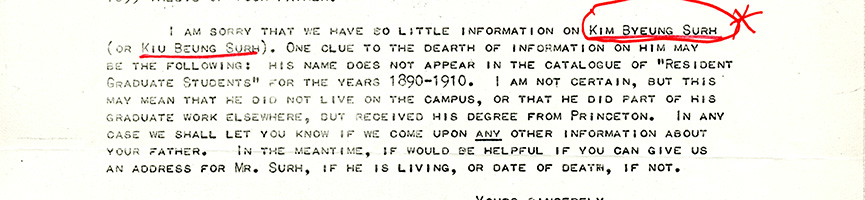
Surh Byung Kyu—whose name is spelled as “Kin” in the October 27, 1898 issue of the Daily Princetonian—was born in Seoul, Korea. The Prince called him the “Corean Prince at Princeton”, noting that he is of a “distinguished family which traces its genealogy back through nearly two thousand years.”
Surh studied English in “the schools of Corea”, then continued his education at Roanoke College in Virginia from 1893. The Prince notes that he identified as a Freemason and was “lately…confirmed in the Episcopal Church” — showcasing Surh’s involvement in Christian life while at the University.
In a letter sent to the Alumni Records office by Surh’s daughter, Anna S. Chesnutt, Surh resided in the U.S. from 1890-1899, then returned to Korea. Chesnutt claims in her letter that Surh’s career after he returned to Korea was “illustrious” and he reportedly played a part in “establishing [the] U.S./Korea relationship.” He also allegedly “organized and was captain of an all alien volunteer auxiliary corps of the U.S. army composed of Princeton alumni” during the Spanish American War.
According to a response sent by University Archives in response to Chesnutt, Surh graduated with an A.M. degree. Despite efforts to find other pertinent information, such as his thesis or coursework, the documents were unable to be found.

7. Bonus Figure: George W. Gilmore
Though not Korean, George W. Gilmore’s work profoundly shaped early Christian education in Korea. Born in 1857 and ordained in 1886, Gilmore was among the first Americans to engage deeply with Korean society through education and religion. He helped found and taught at the Royal Korean College in Seoul and later served as a professor of Biblical History at Bangor Theological Seminary. His writings, including Korea from Its Capital and Animism, offered Western audiences a glimpse into Korean culture and spirituality at a time when the peninsula was opening to global exchange.
Gilmore’s work also reflects the ethnographic assumptions of his era: he remarked in Animism that Japanese, Korean, and Chinese people were “animists” with “primitive modes of thinking.” The book’s alternative title is Thought Currents of Primitive Peoples, with Gilmore repeatedly referring to not only East Asians but also “India, the North Asiatic tribes, Oceanicans, Africans, and American Indians” as fitting under the category of “primitive peoples.” Gilmore’s involvement as a missionary in Korea and his complicated legacy highlights the often complex web of transnational religious and academic relationships that linked Korea and Princeton during the early twentieth century.
Conclusion
The stories of these Korean scholars and pastors illuminate how Christianity shaped both their academic and personal identities during their time at Princeton, enriching their academic studies at the University with enrollment at classes at PTS and engaging with their faith outside of the classroom. Throughout the twentieth century, religion remained central to Princeton’s Korean alumni community, as exemplified by Channing Liem, who went on to continue engaging with his faith by giving sermons as a pastor and leading Methodist congregations.
Today, Princeton continues to host vibrant Christian organizations such as Manna Christian Fellowship — modern continuations of the same spiritual legacy that guided early Korean students at Princeton University. However, Manna is not limited to Koreans: according to the organization’s website, which denotes 1994 as the year of the organization’s beginnings, “a handful of Korean students wanted to reach out to some of their Asian American friends who had stopped going to church or Christian fellowship.” While Korean alumni were the harbingers of the movement, it seems as though they have made attempts to integrate with the wider Christian community — an effort that seems to be continuing today.
Sources:
Alumni Records. Wright Library Special Collections, Princeton Theological Seminary, Princeton, New Jersey.
“About – History.” Manna Christian Fellowship: Princeton, NJ, 2024.
Connor, Phillip. “6 Facts about South Korea’s Growing Christian Population.” Pew Research Center, August 12, 2014.
Graduate Alumni Records 1839-1899 (AC105-01).
Graduate Alumni Records 1900-1929 (AC105-02).
Graduate Alumni Records 1930-1959 (AC105-03).
Hamilton, Angus. Map of Korea. London: Edward Stanford, 1904.
Houchins, Lee, and Chang-su Houchins. “The Korean Experience in America, 1903-1924.” Pacific Historical Review 43, no. 4 (1974): 548–75.
Kim, Andrew Eungi. “Christianity, Shamanism, and Modernization in South Korea.” CrossCurrents 50, no. 1/2 (2000): 112–19.
Lee, Claire. “Diversity in the American Church: A Case Focus on the Korean Immigrant Church,” Global Tides: Vol. 17, Article 6.
Park, Chung-shin. “Protestantism in Late Confucian Korea: Its Growth and Historical Meaning.” The Journal of Korean Studies (1979-) 8 (1992): 139–64.
Park, Kyeyoung. “The Comforts of Christianity for Korean Immigrants: Religion and Reproduction of Small Business Activity.” In The Korean American Dream: Immigrants and Small Business in New York City, 183–98. Cornell University Press, 1997.
Sascha O. Becker, Cheongyeon Won, “Conquering Korea for Jesus: Protestant missionaries, local churches, and literacy in Colonial Korea.” Labour Economics, Volume 91, 2024.